

| Area: 1,449 Acres | ||
| Lat: | ||
| Lon: | ||
| Nearby Services | ||
 |  |  |
| Site Facilities | ||
 |
 |
|
| Join Our Mailing List |
|
For Email Marketing you can trust
|

|
Top Banner Photo Credits
Gary Skipper
American Pika
Rich Warren
Bullocks Oriole
Cindy Croissant
Yellow-faced Bumble Bee
Samira Furlan
Channel Islands National Park Island Fox
Annette Siegel
Young Oystercatcher
Chih-Hsin Wang
Great Egret
Kaelyn DeYoung
San Joaquin Antelope Squirrel
Gary Skipper
American Pika
Rich Warren
Bullocks Oriole
Cindy Croissant
Yellow-faced Bumble Bee
Samira Furlan
Channel Islands National Park Island Fox
Annette Siegel
Young Oystercatcher
Chih-Hsin Wang
Great Egret
Kaelyn DeYoung
San Joaquin Antelope Squirrel
© 2008-2026 California Watchable Wildlife and SnowlineGraphics.com
| Bolsa Chica Ecological Reserve - Site # 37 | |||
| The Bolsa Chica Wetlands are remnants of a once-extensive marshland. The freshwater of Freeman Creek, a tributary of the Santa Ana River, flowed into the marshes, meeting water from the Pacific Ocean, and creating a brackish environment. The swampland supported dense vegetation, including tulles, arroyo, willows and thickets, as well as diverse wildlife, such as grizzly bears, bobcats, mule deer and antelope! | |||
| |||
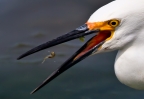
| Background: | This bolsa chica, or 'little pocket' of restored urban salt marsh is a haven for waterbirds, such as American wigeons, blue-winged teal, lesser scaups, brown pelicans, and great blue herons. Red-necked phalaropes, dowitchers, and other shorebirds feed on mudflats fringed with pickleweed that shelters marsh wrens and endangered Belding's savannal sparrows. From the boardwalk, use binoculars to watch two nesting islands for black skimmers and five tern species, including endangered California least terns. Look below the boardwalk for giant sea hares. Utility poles become perches for birds of prey, including ospreys and peregrine falcons. Broad mesas shelter finches, bushtits, and towhees; the grasslands attract burrowing and short-eared owls. Look for wintering monarch butterflies at the bluff overlooking a eucalyptus grove. | ||
| The Habitat: | Natural beauty and a rich cultural history await discovery at the Bolsa Chica Ecological Reserve (BCER). At 1,449 acres, the Bolsa Chica Wetlands is the largest saltwater marsh between Monterey Bay and the Tijuana River Estuary. Approximately 5 miles of trails can be explored from sunrise to sunset. Since Bolsa Chica is home to rattlesnakes, black widows, coyotes, and poison oak as well as many rare and endangered species, it is important that visitors stay on designated trails. There is no charge to hike the Bolsa Chica Ecological Reserve or to visit the Interpretive Center. | ||
| Wildlife and Where to Find It: | More than 200 bird species. High probability of seeing shorebirds in fall, waterfowl in winter. Marine birds are seen from April to August, songbirds in sprin and summer. Belding's savannah sparrows are easiest to find when singing, in March and April. Look for peregrine falcons in fall, short-eared owls from October through January. MANY CLOSED AREAS. TERNS NEST IN SAND; DO NOT DISTURB NESTING SITES. | ||
| Nearby Viewing Sites: | Crystal Cove State Beach Upper Newport Bay Ecological Reserve and Regional Park | ||
| Festivals & Events: | Public Tours are on the last Saturday of every month at 10am Birding Tours are on the first Saturday of every month at 10am Beginner Birder Workshops are on the 3rd Sunday of every month from 9am-Noon | ||
| Visitor Information: | Visit Huntington Beach - 714-969-3492 / 800-729-6232 - http://www.surfcityusa.com | ||
| Road Information: |  Paved. Paved. | ||
| Road Hazards: | |||
 Number of Parking Spaces: 0 Number of Parking Spaces: 0 | |||
| Parking Fee: No | |||
| Proximity to viewing area: | |||
 Pull-Through Parking: Pull-Through Parking: | |||
| Parking Notes: The Bolsa Chica Wetlands Interpretive Center is located at 3842 Warner Avenue, which is at the southeast corner of Warner Avenue and Pacific Coast Highway. A second parking lot is located on the east side of PCH, 1 mile south of Warner. | |||
| How to Get There: | From Highway 405, take Warner Avenue west about 3 miles to Highway 1 junction and turn south. Continue about 1 mile on Highway 1 to entrance. | ||
| Contact Information | |||
| Managing Agency: | California Department of Fish & Wildlife | ||
| Agency Site URL: | |||
| Physical Address: | Southeast corner - intersection of Warner Avenue Huntington Beach, CA |
Agency 2: | 3842 Warner Avenue Huntington Beach, CA 92649-4263 |
| Manager Phone: | 714-846-1114 | ||
| Site Phone: | 714-846-1114 | ||
| County: | Orange | ||
| Addition Website: | http://bolsachica.org | ||